
The Self-Regulating Ecosystem

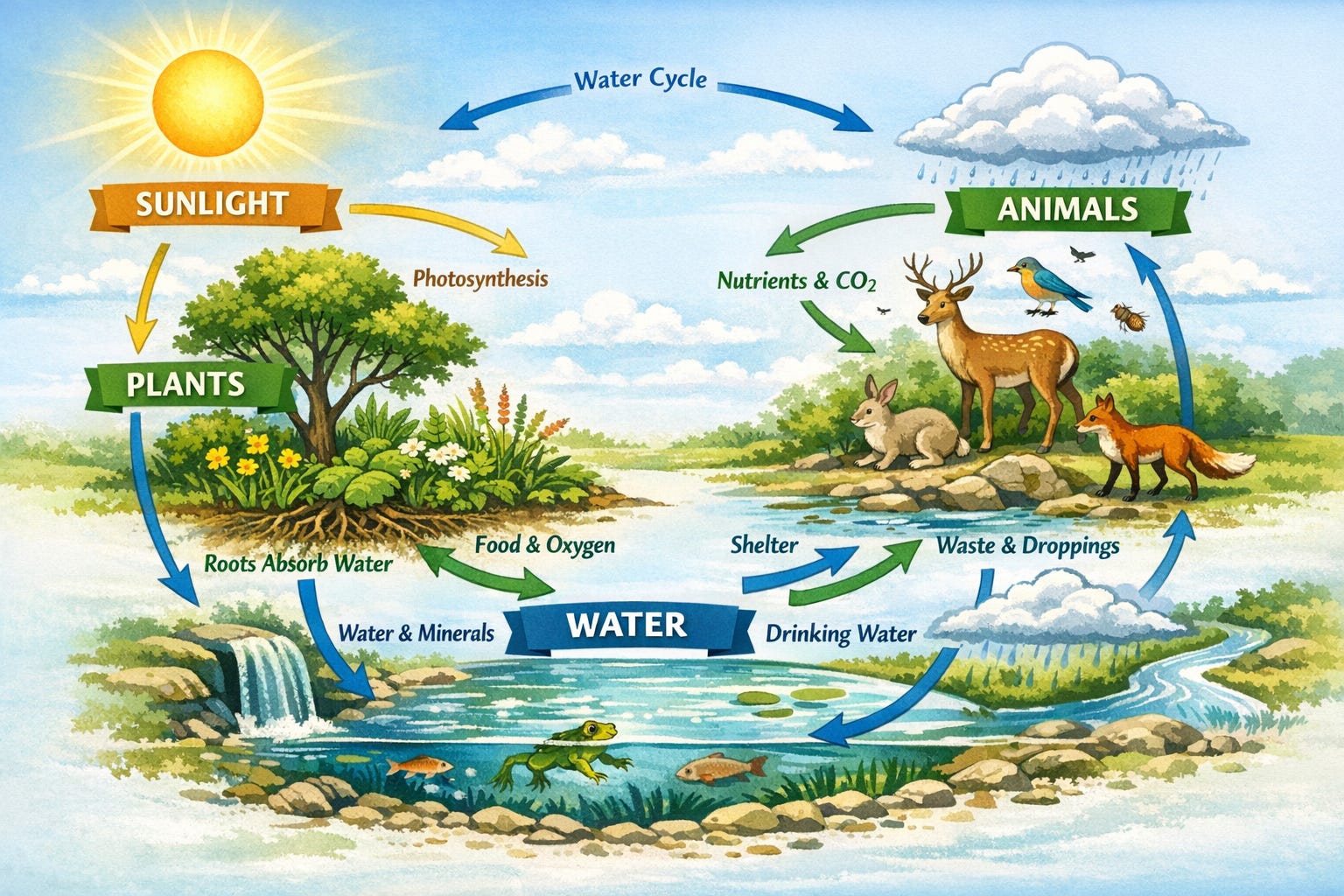
1.The Planet Is Running a System Way Bigger Than Us - If you ever stop scrolling your phone for a second and just look at nature — a forest, a river, even a random park — something pretty crazy starts to become obvious. The natural world is not just a bunch of random plants and animals doing their own thing. It actually behaves more like a massive interconnected system where every living thing is part of something bigger.
Scientists call that system an ecosystem.
Now, that word gets used a lot in school textbooks and documentaries, but when you really think about what it means, it’s actually kind of mind-blowing. An ecosystem is basically a huge network of organisms interacting with each other and with their physical environment. Plants, animals, fungi, bacteria, insects, soil, water, sunlight, temperature — everything is part of the same system.
And here’s the wildest part.
Nobody is running it.
There is no central control center for forests.
There is no manager organizing the ocean.
There is no authority coordinating every species.
Yet ecosystems somehow stay stable for hundreds or even thousands of years.
That’s why scientists describe ecosystems as self-regulating systems.
What that means is simple but powerful: nature has built-in mechanisms that allow ecosystems to balance themselves. When something changes inside the system — like a population boom, a drought, or a new species appearing — other parts of the system respond automatically.
It’s almost like the ecosystem is constantly adjusting its own settings.
Imagine a giant machine that never stops running. Now imagine that machine automatically fixing its own problems without a mechanic.
That’s basically what an ecosystem does.
If one species grows too quickly, predators respond.
If nutrients become scarce, plants adapt.
If environmental conditions shift, species migrate or evolve.
In other words, ecosystems operate through continuous feedback and adjustment.
They’re not static. They’re not frozen in place.
They’re dynamic systems constantly moving toward balance.
And the more scientists study ecosystems, the clearer it becomes that nature behaves a lot like a complex adaptive network.
Think about it like the internet.
Millions of nodes interacting with each other.
No single node controlling the whole system.
Yet somehow the network still functions.
Nature figured out distributed systems long before humans invented computer science.
The moment you start thinking about ecosystems this way, you realize something important:
Nature isn’t chaotic.
It’s organized — just not in the way humans usually organize things.
2.The Hidden Control System: Feedback Loops - So how exactly do ecosystems keep themselves balanced without a central authority?
The answer lies in something scientists call feedback loops.
This might sound technical, but the idea is actually super simple. A feedback loop is basically a chain of cause-and-effect relationships where one change eventually influences the thing that caused it in the first place.
In other words, the system reacts to itself.
Let’s look at a simple example from nature.
Imagine a grassland ecosystem where rabbits live.
At some point, the rabbit population begins to grow rapidly. Maybe there was a mild winter, maybe food was abundant, maybe predators were temporarily scarce. Whatever the reason, suddenly there are a lot more rabbits than usual.
At first, that seems great for rabbits.
More rabbits means more reproduction.
More reproduction means even more rabbits.
But ecosystems rarely allow unlimited growth.
Because as rabbit numbers increase, something else happens.
Predators notice.
Foxes, hawks, and other predators suddenly have a buffet of easy food. That means predator populations start increasing too.
More predators means more rabbits being hunted.
And eventually the rabbit population begins to decline again.
What you’re seeing here is a classic ecological feedback loop.
The system responds to change by adjusting itself.
Scientists call this type of mechanism negative feedback.
Negative feedback doesn’t mean something bad — it simply means a process that stabilizes the system.
Think of it like the thermostat in your house.
If the room gets too cold, the heater turns on.
If the room gets too warm, the heater turns off.
The system keeps adjusting itself to maintain balance.
Ecosystems do the same thing.
Except instead of electronics and sensors, they rely on biological interactions between species.
Predation. Competition. Resource availability.
These interactions create natural regulation mechanisms.
And that’s one of the reasons ecosystems can remain stable over long periods of time.
But ecosystems don’t only use negative feedback.
Sometimes they experience something called positive feedback loops.
These are situations where change amplifies itself instead of stabilizing.
For example, imagine a forest where a large number of trees are suddenly removed due to logging.
Without trees, the soil becomes more exposed to wind and rain. That leads to erosion. As erosion increases, it becomes harder for new trees to grow.
Fewer trees lead to more erosion.
More erosion leads to even fewer trees.
The system begins spiraling away from its previous balance.
Positive feedback loops can push ecosystems toward major transformations.
Sometimes those transformations create new ecosystems.
Sometimes they cause ecological collapse.
Either way, they show that ecosystems are not static — they are complex systems capable of dramatic change.
3.Biodiversity: Nature’s Built-In Backup System - Another major reason ecosystems are able to regulate themselves is biodiversity.
Biodiversity simply means the variety of life within an ecosystem.
Different species of plants.
Different animals.
Different microorganisms.
Different ecological roles.
At first glance, biodiversity might just seem like nature being “colorful” or “interesting”.
But in reality, biodiversity performs a much deeper function.
It makes ecosystems more stable.
Think about it like this.
In human technology systems, engineers often build redundancy into their designs. Airplanes have multiple backup systems. Data centers have duplicate servers. Power grids have alternative routes for electricity.
Why?
Because redundancy prevents system failure.
If one component stops working, another component can take over.
Ecosystems operate in a very similar way.
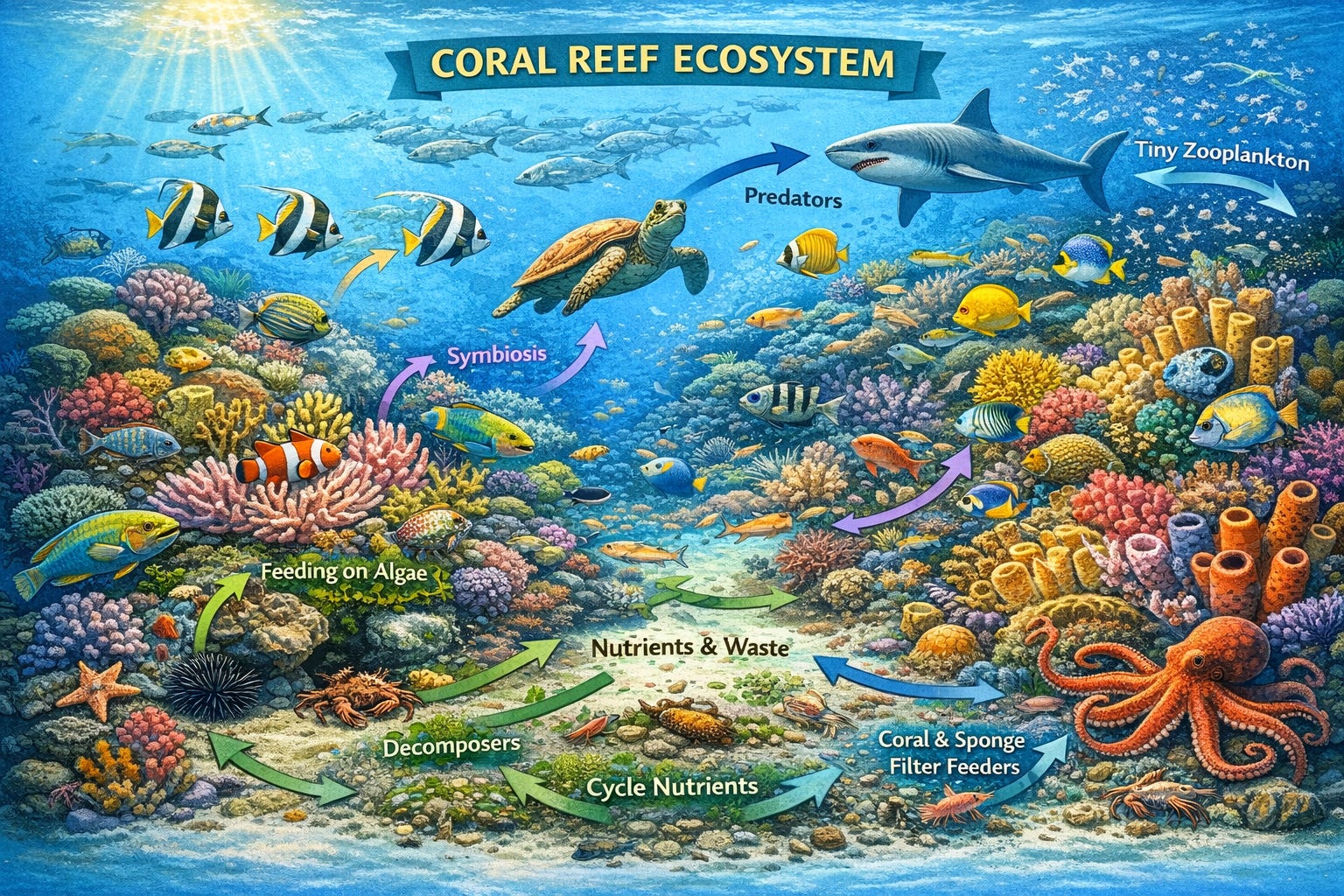
In a highly diverse ecosystem, many species perform similar ecological roles.
There might be dozens of species that pollinate plants.
Several predators that control herbivore populations.
Multiple fungi that decompose organic matter.
If one species disappears due to disease or environmental change, others can partially fill the gap.
This redundancy acts as a natural safety net.
It prevents ecosystems from collapsing when something goes wrong.
That’s why ecosystems with extremely high biodiversity — like tropical rainforests and coral reefs — tend to be incredibly resilient.
They contain thousands of interacting species forming complex ecological networks.
These networks allow the system to absorb shocks and continue functioning.
In contrast, ecosystems with very low biodiversity are often more fragile.
If a single key species disappears, the entire system may struggle to adapt.
So biodiversity is not just about beauty or variety.
It is one of the fundamental mechanisms that allows ecosystems to regulate themselves.
Nature has essentially created a distributed network of biological roles, ensuring that no single species carries all the responsibility.
Again, it’s surprisingly similar to how modern engineers design complex systems.
4.When Humans Interfere With the System -
For most of Earth’s history, ecosystems regulated themselves without much interference.
But in the last few centuries, human activity has begun affecting ecosystems in ways that sometimes disrupt their natural regulatory mechanisms.
One of the clearest examples of this comes from top predators.
Top predators — animals like wolves, sharks, and big cats — often play a crucial role in maintaining ecosystem balance. They control herbivore populations and influence the behavior of other species.
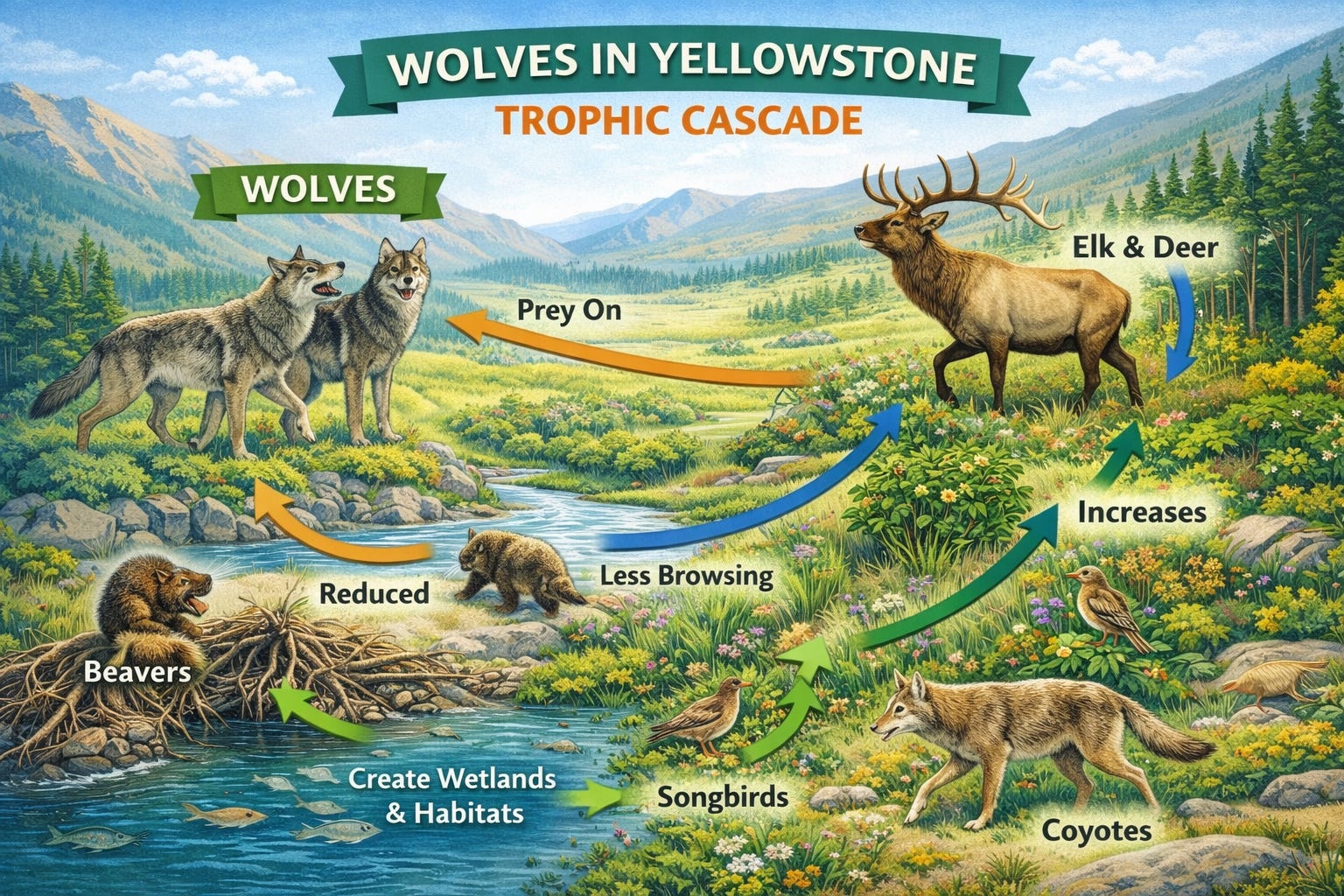
When these predators disappear, ecosystems can experience something called a trophic cascade.
A trophic cascade is basically a chain reaction that spreads through the food web.
A famous example happened in Yellowstone National Park.
For decades, wolves were hunted and removed from the ecosystem. Without wolves, deer populations increased dramatically.
At first, this didn’t seem like a problem.
But soon the consequences became obvious.
The deer began overgrazing vegetation along rivers and streams. Trees and shrubs disappeared. Without plants holding the soil together, riverbanks eroded.
Birds lost their nesting areas. Beavers disappeared because the trees they used for dams were gone.
The entire ecosystem began shifting.
Then something remarkable happened.
In 1995, wolves were reintroduced to Yellowstone.
Slowly but surely, the ecosystem began recovering.
Deer populations stabilized.
Vegetation returned.
Beavers rebuilt wetlands.
Bird populations increased.
Even river patterns changed because vegetation stabilized the soil again.
One species helped restore balance to the entire system.
This phenomenon showed scientists something incredibly important:
Ecosystems are deeply interconnected networks where even small changes can ripple across the entire system.
And it also showed that restoring key species can sometimes help ecosystems regain their natural regulatory balance.
5.The Big Realization: Ecosystems Are Complex Adaptive Systems - The deeper scientists study ecosystems, the more they begin to look less like simple food chains and more like complex adaptive systems.
A complex adaptive system is a system made of many interacting parts that can adjust and evolve over time.
Examples include:
• the human brain
• the global economy
• the internet
• ecosystems
In these systems, no single component controls everything.
Instead, order emerges from countless interactions between smaller parts.
In ecosystems, those parts are organisms and environmental factors.
Each organism responds to local conditions:
food availability
• predators
• competition
• temperature
• water
These responses create patterns across the ecosystem.
Over time, those patterns produce large-scale stability.
It’s almost like ecosystems are running a decentralized algorithm for survival.
Every organism is processing information from its environment and reacting accordingly.
The result is a system capable of regulating itself without centralized control.
This is why ecosystems have survived massive environmental changes throughout Earth’s history:
ice ages
volcanic eruptions
meteor impacts
climate shifts
They adapt.
They reorganize.
They find new balances.
And this leads to one of the most important lessons humanity can learn from ecology:
We are not separate from ecosystems.
Our cities, farms, industries, and economies all exist inside the same planetary system.
When ecosystems are stable, life on Earth thrives.
When ecosystems break down, everything becomes more uncertain.
Understanding ecosystems as self-regulating systems helps us see the planet in a completely different way.
Not as a collection of resources to exploit.
But as a living network that sustains life.
And once you realize that…
You start asking a different question.
Not “How do we control nature?”
But “How do we live inside systems that already know how to balance themselves?”
-Nana
I studied it as "Control Systems" in college. The lecturer was dead boring and it was just math, vectors, and forces.
I much prefer your article - real.
What if, as a species, we became ecocentric vs. egocentric? What a wonderful wish for the world that would be. Great writing, you have a gift.